If you’ve ever sat in a Tesla and watched the steering wheel turn itself around a highway curve, you already know why this technology gets so much attention. It’s impressive the first time you see it — and a little unnerving, too.
But“Tesla Autopilot” has also become one of the most misunderstood terms in the car industry. Some people think it means the car drives itself. Others assume it’s the same thing as Full Self-Driving. And after a viral YouTube video from Mark Rober showed a Tesla failing to stop for a painted wall, a lot of people started asking a more basic question: is this thing actually safe?
This guide breaks down what Tesla Autopilot really is, how it works under the hood, what it costs in 2026, how it differs from FSD, and what the crash data and independent testing actually show. By the end, you’ll have a clear, honest picture — not marketing language, not internet hysteria.
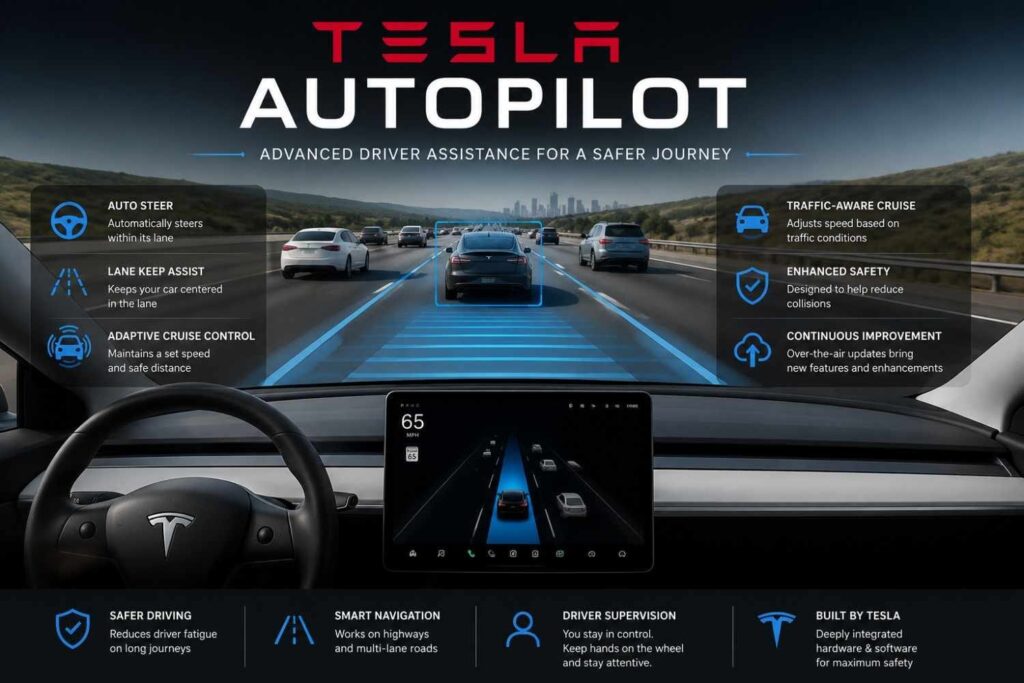
Table of Contents
What Is Tesla Autopilot?
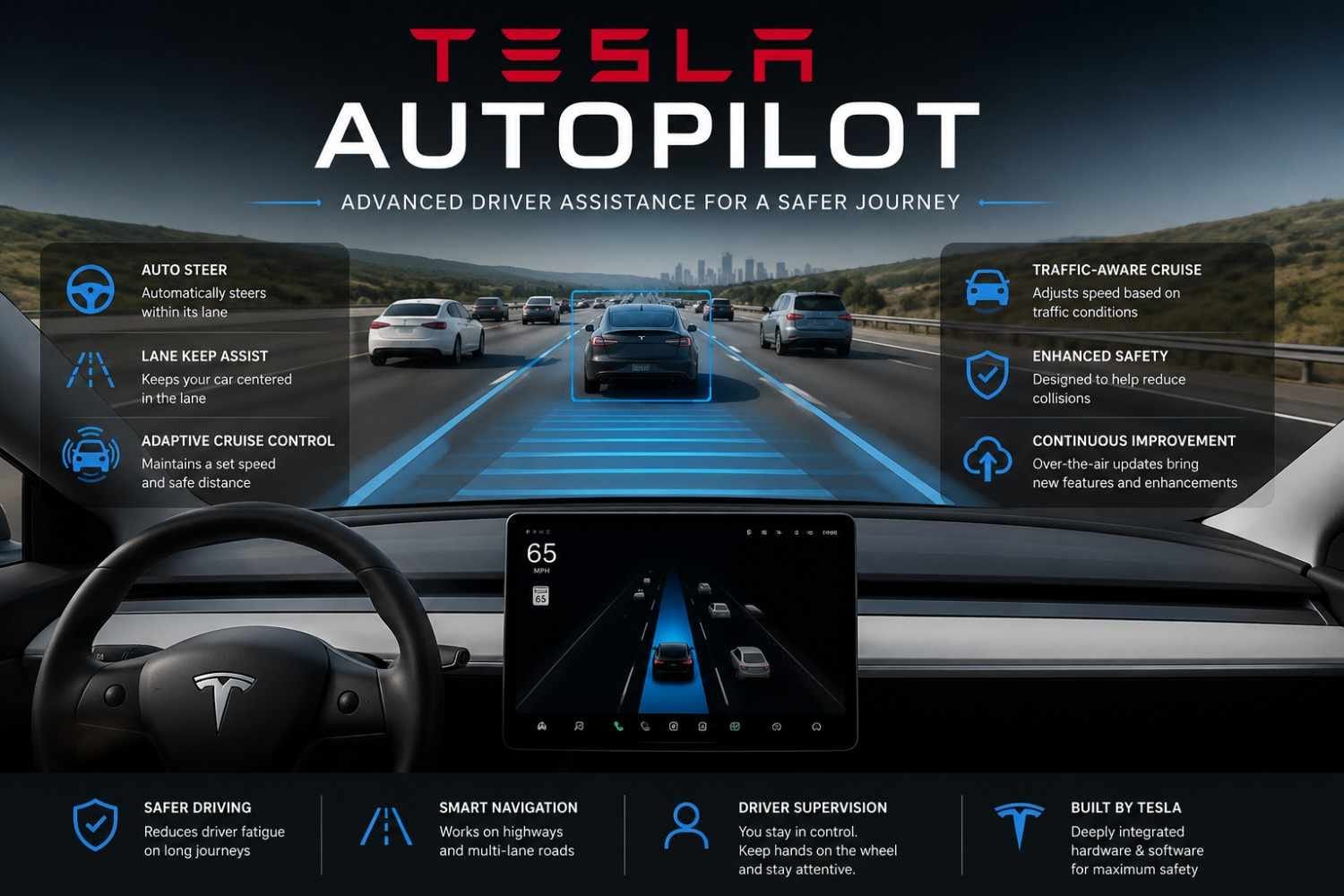
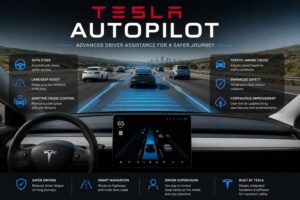
Tesla Autopilot is a driver-assistance system, not a self-driving system. It’s classified as SAE Level 2 automation, which means the car can handle certain driving tasks, but a licensed driver must stay alert, keep their hands ready on the wheel, and be prepared to take control at any moment.
Autopilot first arrived on Tesla vehicles in 2014 as an optional hardware package, and it has changed shape many times since. In its current form, standard Autopilot includes:
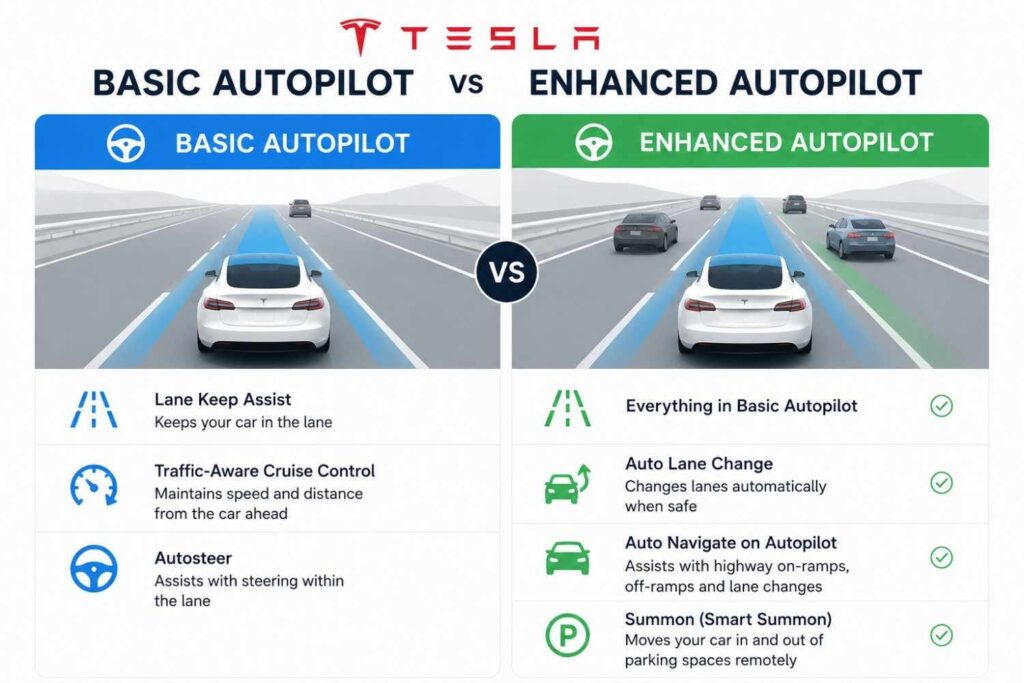
- Traffic-Aware Cruise Control – matches your speed to the flow of traffic and the car ahead
- Autosteer – keeps the car centered in its lane on clearly marked roads
That’s the core of it. It is essentially a smarter, more attentive version of adaptive cruise control — think of it as a highway co-pilot, not a chauffeur.
Basic Autopilot vs. Enhanced Autopilot
For years, Tesla also sold a mid-tier package called Enhanced Autopilot (EAP), which added features like automatic lane changes, Navigate on Autopilot (automated highway on/off-ramp merging), Auto Park, and Smart Summon. Enhanced Autopilot has since been phased out for new buyers, but many existing owners still have it, and Tesla has continued to offer them discounted upgrade paths to its newer software.
How Does Tesla Autopilot Work?
Understanding how does Tesla Autopilot work starts with the car’s sensor suite. Since 2021, Tesla has relied entirely on cameras — a setup the company calls “Tesla Vision” — rather than the radar and ultrasonic sensors used in earlier models. Eight cameras positioned around the vehicle capture a 360-degree view of the surrounding environment.
Here’s the basic process:
- Perception – The cameras feed continuous video into Tesla’s onboard computer, which identifies lane lines, other vehicles, pedestrians, traffic signs, and road edges.
- Prediction – Neural networks, trained on billions of miles of real driving data collected from Tesla’s global fleet, predict what nearby objects are likely to do next.
- Planning and control – The system calculates a safe path and translates it into steering, acceleration, and braking commands.
Why Tesla Ditched Radar and Lidar
This vision-only approach is one of the most debated engineering decisions in the industry. Tesla’s argument is that humans drive using eyes alone, so a sufficiently advanced camera-and-neural-network system should be able to do the same — and cameras are far cheaper to manufacture at scale than lidar. Critics, including several rival automakers and some of Tesla’s own former engineers, argue that cameras alone struggle in situations like heavy glare, fog, or unusual visual patterns — a concern that has come up repeatedly in regulatory reviews and public tests (more on that below).
Tesla Autopilot vs. FSD: What’s the Real Difference?
This is probably the single most common point of confusion, so let’s clear it up. When people compare Tesla Autopilot vs FSD, they’re really comparing three different tiers of the same underlying hardware:
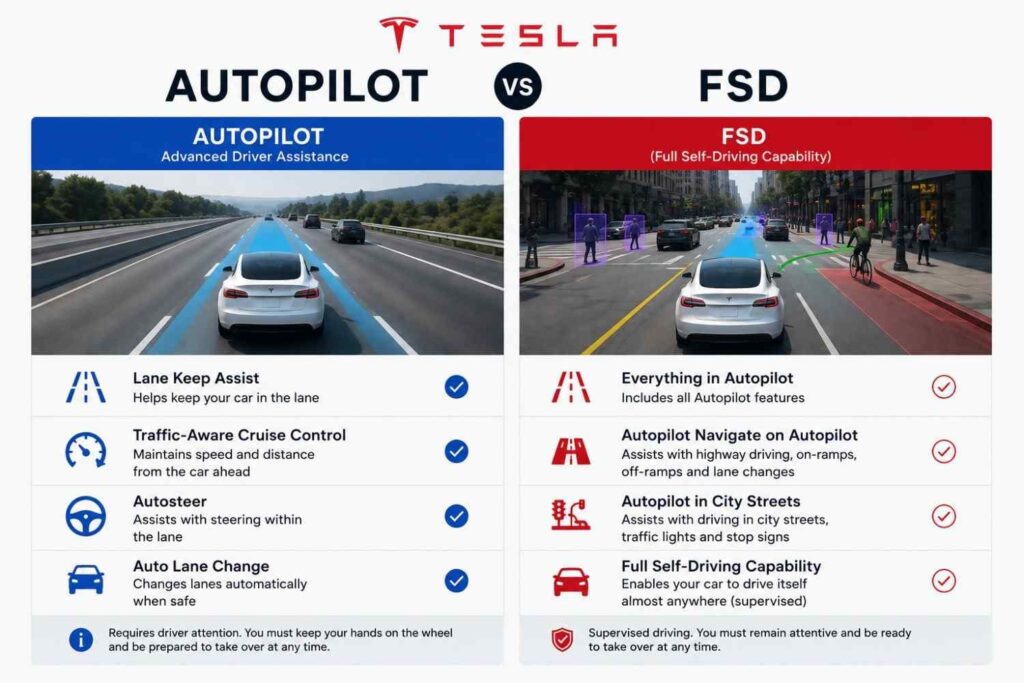
| Feature | Basic Autopilot | Enhanced Autopilot (legacy) | Full Self-Driving (Supervised) |
| Lane centering | Yes | Yes | Yes |
| Traffic-aware cruise control | Yes | Yes | Yes |
| Automatic lane changes | No | Yes | Yes |
| Navigate on Autopilot | No | Yes | Yes |
| Auto Park / Summon | No | Yes | Yes |
| Stop sign & traffic light recognition | No | No | Yes |
| City street driving | No | No | Yes |
| Automatic turns at intersections | No | No | Yes |
The key thing to remember: FSD (Supervised) is still not autonomous driving. Tesla is explicit that all its current systems, including FSD, require an attentive driver ready to intervene at any moment. Full Self-Driving simply extends the same driver-assistance philosophy from highways into city streets and intersections.
Tesla Autopilot Cost in 2026
Pricing here has shifted significantly over the past year, so it’s worth being precise. As of mid-2026:
- Basic Autopilot now comes standard on new Teslas as Traffic-Aware Cruise Control, but full lane-centering (Autosteer) has moved behind a paid tier on new orders.
- FSD (Supervised) is now subscription-only. Tesla ended the option to buy it outright in February 2026, when the final one-time purchase price sat around $8,000.
- Standard monthly subscription: roughly $99 per month for most owners.
- Discounted rate: around $49 per month for owners who previously purchased the older Enhanced Autopilot package, since they’ve already paid for part of the feature set.
If you already own a car with Enhanced Autopilot, Tesla has also offered a discounted one-time upgrade path to the full FSD software stack, priced well below the old outright purchase cost. Elon Musk has publicly indicated that subscription pricing is likely to rise as the software’s capabilities expand, so the current rate shouldn’t be treated as permanent.
The bottom line: subscribing is now the only way to try FSD, which lowers the barrier to entry but means the cost never fully goes away unless you cancel.
Tesla Autopilot Crash Data and Safety Investigations
Safety is where the Autopilot conversation gets serious, and it deserves a clear-eyed look rather than either side’s talking points.
Tesla publishes its own quarterly safety reports, comparing crash rates for vehicles using Autopilot against the general population of U.S. drivers. The company argues these numbers show Autopilot-engaged miles are safer, on average, than unassisted driving.
At the same time, federal regulators have taken the issue seriously enough to open dozens of formal reviews. The National Highway Traffic Safety Administration (NHTSA) has opened more than 40 special crash investigations into Tesla vehicles using Autopilot or FSD since 2016, and more than a dozen of those crashes involved a fatality. In 2024, NHTSA opened a preliminary evaluation into whether FSD-equipped vehicles struggle to detect obstacles in reduced-visibility conditions like sun glare, fog, or dust. By early 2026, that review had been escalated to a full engineering analysis — a required step before regulators can pursue a recall — covering more than 3 million vehicles across the Model S, X, 3, Y, and Cybertruck lineup.
A few things worth keeping in mind if you’re weighing a Tesla autopilot crash story you’ve seen in the news:
- Correlation isn’t always causation. Not every crash reported with Autopilot “engaged” happened because of the system; some involve driver misuse, distraction, or conditions the driver should have overridden.
- Reporting rules matter. Tesla is required to report crashes involving its driver-assistance systems under NHTSA’s Standing General Order, which is one reason Tesla’s crash-reporting numbers can look larger than competitors’ — they’re required to disclose more, not necessarily because the underlying tech is worse.
- Investigations are ongoing. As of mid-2026, NHTSA’s most active review centers specifically on how the vision-only system performs when visibility is degraded, which lines up with several of the pain points independent testers have also flagged.
If you drive with Autopilot or FSD, the safest approach is to treat every claim in either direction with some healthy skepticism and keep your hands and eyes engaged, regardless of what the marketing name implies.
The Mark Rober Tesla Autopilot Test: What Actually Happened
No modern conversation about Tesla’s safety technology is complete without addressing the Mark Rober Tesla Autopilot test, which became one of the most-viewed automotive videos of the year.
The former NASA engineer, now known for his YouTube science content, set up a side-by-side comparison: a Tesla Model Y running Autopilot against a Lexus RX modified with a lidar sensor supplied by Luminar. Across a series of obstacle tests — a stationary mannequin, a mannequin in fog, a mannequin in heavy rain — the lidar-equipped vehicle stopped consistently. The Tesla struggled in several of the low-visibility scenarios.
The most talked-about moment came last: a wall painted to look like a continuation of the road, styled after the classic Wile E. Coyote cartoon trick. The lidar car detected the wall and stopped. The Tesla drove straight through it.
The video sparked immediate, intense pushback from Tesla supporters, who raised a few fair points:
- Rober tested Autopilot, not FSD — Tesla’s more advanced, camera-plus-neural-network system for complex environments.
- Critics accused Rober of disengaging Autopilot moments before impact and questioned whether some clips were reshot, which he denied while releasing raw footage.
- A separate YouTuber later repeated a similar wall test using FSD on newer hardware and got mixed results — a Cybertruck on Tesla’s latest hardware stopped successfully, while an older Model Y running older hardware still failed.
Whatever you think of the methodology, the test struck a nerve because it highlighted a legitimate, ongoing engineering question: how does a camera-only system handle scenes designed to visually deceive it, and how does that compare to systems that use depth-sensing hardware like lidar? That’s the same underlying question regulators are currently investigating.
Tips for Using Tesla Autopilot Safely
Whether you’re a new owner or considering a subscription, a few practical habits go a long way:
- Keep your hands on the wheel and eyes on the road, even when the system is confidently holding its lane. Tesla’s own cabin camera monitors driver attentiveness and will disengage the system if it detects prolonged inattention.
- Use it on the roads it was designed for. Basic Autopilot performs best on well-marked highways, not complex urban intersections.
- Don’t trust it fully in bad weather. Heavy rain, fog, and glare are documented weak points across independent tests and regulatory findings.
- Keep your software updated. Tesla frequently ships over-the-air improvements that address exactly these kinds of edge cases.
- Know which system you actually have. Basic Autopilot, Enhanced Autopilot, and FSD behave very differently, and knowing your specific configuration matters more than the marketing name on the box.
Frequently Asked Questions
What is Tesla Autopilot, in simple terms? It’s a driver-assistance system that keeps your Tesla centered in its lane and matched to traffic speed on well-marked roads. It is not self-driving, and the driver must stay attentive at all times.
Is Tesla Autopilot free or does it cost extra? Traffic-Aware Cruise Control now comes standard, but full Autosteer lane-centering and the more advanced FSD (Supervised) software are separate paid features. As of 2026, FSD is subscription-only, priced around $99 per month for most owners.
What’s the difference between Tesla Autopilot and FSD? Autopilot handles highway-style driving: lane centering and adaptive cruise control. FSD (Supervised) extends those capabilities to city streets, intersections, stop signs, and traffic lights — but it still requires an attentive driver at all times.
Did the Mark Rober test prove Tesla Autopilot is unsafe? It demonstrated a real limitation of camera-only systems in a specific, engineered scenario — a painted wall designed to visually fool the cameras. It doesn’t prove the system is unsafe in typical daily driving, but it does echo concerns regulators are actively investigating around low-visibility performance.
Has NHTSA found Tesla Autopilot to be dangerous? NHTSA hasn’t issued a blanket safety ruling, but it has opened dozens of special crash investigations since 2016 and, as of 2026, has an active engineering analysis focused on how Tesla’s camera-based systems perform in reduced-visibility conditions like fog, glare, and dust.
Final Thoughts
Tesla Autopilot is a genuinely useful piece of technology when you understand its limits — a highway assistant that reduces driver fatigue, not a robot chauffeur. The confusion, and the controversy, almost always comes from treating it as more capable than it actually is.
If you’re considering a Tesla, or you already own one and are deciding whether FSD is worth the subscription, the smartest move is to test it yourself on a familiar route before committing long-term, and to stay plugged into safety updates from both Tesla and independent testers as the technology — and the regulatory scrutiny around it — continues to evolve.
Thinking about subscribing to FSD or upgrading your Autopilot package?
Check Tesla’s current software offerings directly through your vehicle’s touchscreen or the Tesla app, and compare the feature list against your actual driving needs before you pay for capabilities you may not use.
If you’re interested in the latest automotive innovations, you can also explore our detailed guide on the 2026 Subaru Outback Hybrid, covering its hybrid powertrain, expected features, performance, and release details.