
Artificial Intelligence is everywhere today — writing content, generating images, answering questions, and even coding. But most people still don’t truly understand how AI models work, how AI learns from data, or what really happens during the process of training AI models.
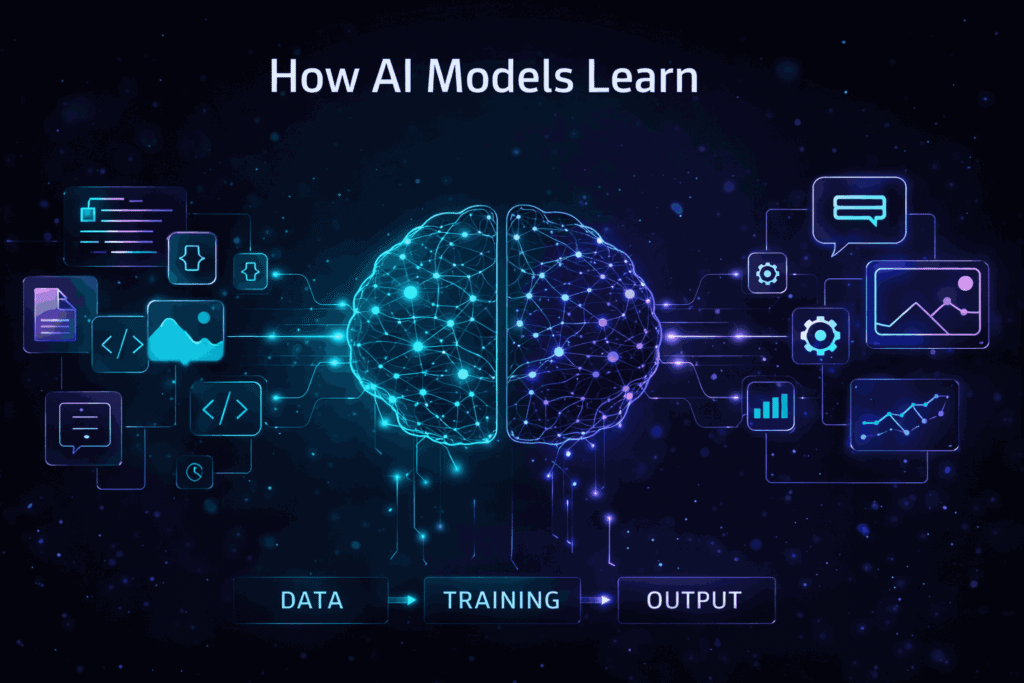
This article explains, in simple language, how AI works step by step, how machine learning models are trained, how LLMs work, and how generative AI systems like ChatGPT function behind the scenes.
What Is an AI Model?
An AI model is a computer system trained on large amounts of data to recognize patterns and make predictions.
In simple words, an AI model:
- Observes data
- Learns patterns
- Predicts outcomes based on probability
This basic idea explains how AI models are created and why AI does not “think” like humans.
Source:
https://www.ibm.com/topics/artificial-intelligence
How AI Models Work
At a high level, how AI models work can be broken into three stages:
- Training – learning from data
- Validation – checking accuracy
- Inference – producing outputs
AI does not understand meaning or intent.
AI predicts the most likely result based on patterns learned during training.
Source:
https://developers.google.com/machine-learning/crash-course/ml-intro
The Process of Training AI Models (Step by Step)
The process of training an AI model follows a structured pipeline. These are the main stages involved in the process of training AI models.
Step 1: Data Collection
AI models learn from massive datasets such as:
- Text (articles, books, websites)
- Images
- Videos
- Audio
- Code
The quality and diversity of data directly impact model accuracy and bias.
Source:
https://www.ibm.com/topics/machine-learning-data
Step 2: Data Cleaning and Preparation
Raw data is noisy and unusable in its original form. Engineers clean data by:
- Removing duplicates
- Fixing errors
- Normalizing formats
- Labeling data (if required)
This step often consumes the majority of the training timeline.
Source:
https://developers.google.com/machine-learning/data-prep
Step 3: Model Architecture and Modelling
Choosing the structure of the model is called the process of modelling.
Common architectures include:
- Neural networks
- Convolutional neural networks
- Transformer models (used in LLMs)
This decision determines how information flows inside the AI model.
Source:
https://arxiv.org/abs/1706.03762
Step 4: Training the AI Model
This is the core training process of AI.
The model:
- Takes input data
- Makes predictions
- Compares results with correct answers
- Adjusts internal parameters
This loop runs millions or billions of times using optimization algorithms.
Source:
https://developers.google.com/machine-learning/crash-course/backpropagation
Step 5: Evaluation and Validation
After training, the model is tested on unseen data to measure:
- Accuracy
- Error rate
- Generalization ability
This ensures the model has learned patterns, not memorized data.
Source:
https://developers.google.com/machine-learning/crash-course/validation
Step 6: Fine-Tuning
Fine-tuning improves performance by:
- Training on specialized datasets
- Reducing incorrect outputs
- Improving alignment and safety
This step is critical for generative AI and LLM systems.
Source:
https://openai.com/research
Step 7: Deployment and Inference
Once training is complete, the model is deployed.
At this stage:
- Learning stops
- The model only predicts outputs
This is how AI tools and apps are used by real users.
Source:
https://cloud.google.com/ai/docs/inference
How Machine Learning Models Work
Machine learning is a subset of AI.
The machine learning training process follows these steps:
- Input data
- Feature extraction
- Model training
- Prediction
These are the fundamental steps of a machine learning model.
Source:
https://www.ibm.com/topics/machine-learning
How AI Learns From Data
AI learns by identifying statistical relationships in data.
For example, when AI sees:
“The capital of France is ___”
It predicts “Paris” because that pattern appears frequently in training data.
This explains how AI learns from data and why biased data creates biased AI.
Source:
https://www.nature.com/articles/d41586-021-01833-0
How LLMs Work (Large Language Models)
LLMs are AI models trained on massive text datasets to predict the next token.
They work by:
- Tokenizing text
- Converting tokens into numerical vectors
- Using transformer layers to analyze context
This explains how LLM works at a fundamental level.
Source:
https://openai.com/research/language-models
Process of Training an LLM
The process of training an LLM includes:
- Tokenization
- Embedding generation
- Transformer-based processing
- Error correction using backpropagation
This is the primary training process of generative AI models.
Source:
https://arxiv.org/abs/2005.14165
How ChatGPT Works
ChatGPT is a large language model fine-tuned using human feedback.
When a user enters a prompt:
- The input is tokenized
- Context is analyzed
- The model predicts the next best tokens
- Responses are generated word by word
This explains how ChatGPT works in practice.
Source:
https://openai.com/blog/chatgpt
Role of GPUs in AI Training
Training AI models requires massive parallel computation.
GPUs are used because they:
- Perform thousands of operations simultaneously
- Handle large datasets efficiently
- Reduce training time drastically
Modern AI is not possible without GPUs.
Source:
https://www.nvidia.com/en-us/deep-learning-ai/
Common Misunderstandings About AI
- AI does not think like humans
- AI does not understand meaning
- AI does not know truth
- AI predicts probabilities
Understanding this removes most AI myths.
Pro Tips for Understanding AI Better
- Focus on data quality, not hype
- Learn the difference between training and inference
- Understand probability-based prediction
- Ignore marketing buzzwords
Summary Table: AI Model Training Stages
| Stage | Description |
|---|---|
| Data | AI observes examples |
| Training | Learns patterns |
| Validation | Tests accuracy |
| Fine-tuning | Improves performance |
| Inference | Produces outputs |
Frequently Asked Questions
What is the process of training AI called?
It is called machine learning training, involving optimization and parameter tuning.
How long does it take to train an AI model?
From hours to months, depending on model size and data volume.
Can beginners train AI models?
Yes, beginners can train small models using open-source tools and cloud platforms.
Conclusion
Now you understand:
- How AI models work
- The process of training AI models
- How machine learning works
- How LLMs and generative AI systems function
AI is not magic.
AI is data, mathematics, and computation working together at scale.
Author
kashyap aditya
AI & Technology Researcher
Read more related articles:-
Vibe Coding Is Exploding in 2026: How Bolt v2, Cursor, Lovable & Windsurf Are Redefining App Developmenthttps://crazyburst.com/vibe-coding-tools-2026/
NVIDIA Nemotron 3 Nano Is Here: The AI That Could Outthink Your Team in 2025https://crazyburst.com/nvidia-nemotron-3-nano-is-here-the-ai-that-could-outthink-your-team-in-2025/
Kimi AI Is Quietly Becoming One of the Most Powerful AI Assistants in 2025https://crazyburst.com/kimi-ai-is-quietly-becoming-one-of-the-most-powerful-ai-assistants-in-2025/