
ChatGPT vs DeepSeek
One AI tries to understand everything.
The other tries to think like a scientist.
Both are powerful.
Both are controversial.
And both are shaping how humans work with intelligence in 2025.
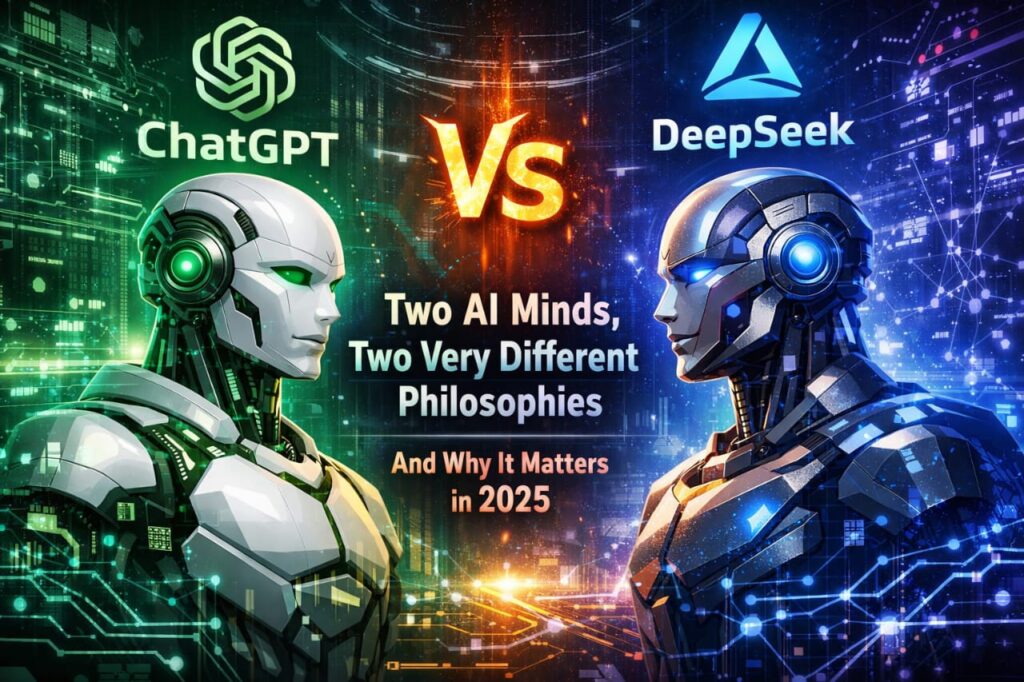
But ChatGPT and DeepSeek are not competitors in the way most people think.
They are built for very different truths.
The Question Nobody Is Asking (But Should)
Most comparisons ask:
“Which AI is better?”
The real question is:
“Better for what — and for whom?”
Because ChatGPT and DeepSeek come from completely different AI philosophies.
Understanding that difference changes everything.
What Is ChatGPT Really Built For?
ChatGPT, developed by OpenAI, is designed as a general-purpose intelligence assistant.
Its goal is not just accuracy — but usefulness.
ChatGPT focuses on:
- Natural conversation
- Creativity
- Problem-solving
- Emotional tone
- Real-world usability
It’s meant to feel like an assistant you can talk to, not a system you must adapt to.
That design choice matters more than benchmarks.
What Is DeepSeek Actually Trying to Solve?
DeepSeek, developed by DeepSeek AI, is built with a different priority:
hard reasoning and mathematical intelligence.
It doesn’t try to sound friendly.
It doesn’t aim to be emotional.
DeepSeek is focused on:
- Logical rigor
- Mathematical reasoning
- Coding correctness
- Scientific problem-solving
It is closer to a research engine than a conversational companion.
And that’s intentional.
The Core Difference in One Sentence
- ChatGPT is optimized for human interaction
- DeepSeek is optimized for intellectual precision
This single difference explains almost every comparison result.
Reasoning & Intelligence: Who Thinks Better?
ChatGPT’s Strength
ChatGPT excels at:
- Explaining complex ideas simply
- Connecting concepts across domains
- Creative reasoning
- Step-by-step problem solving
It may not always give the shortest answer — but it often gives the most useful one.
ChatGPT is trained to help humans understand, not just calculate.
DeepSeek’s Strength
DeepSeek shines when:
- Solving advanced math problems
- Writing efficient algorithms
- Handling formal logic
- Working in research-style environments
It is often more precise, especially in math-heavy tasks.
But that precision sometimes comes at the cost of readability.
Coding Comparison: Practical vs Pure
ChatGPT for Coding
ChatGPT is excellent for:
- Explaining code
- Debugging with context
- Teaching beginners
- Building real-world applications
It thinks like a senior engineer helping a teammate.
DeepSeek for Coding
DeepSeek is strong at:
- Competitive programming
- Algorithm-heavy tasks
- Clean logical implementations
It thinks like a problem solver in a coding contest.
Creativity & Writing: This Is Not Even Close
This is where the gap becomes obvious.
ChatGPT
ChatGPT can:
- Write blogs, scripts, emails, stories
- Match tone and emotion
- Create long-form structured content
- Adapt to audience psychology
This makes it ideal for:
- Bloggers
- Marketers
- Students
- Creators
DeepSeek
DeepSeek can write text — but:
- Tone is neutral
- Creativity is limited
- Emotional understanding is minimal
It is not designed for storytelling or persuasion.
And it doesn’t try to be.
Multimodal Abilities: Seeing, Hearing, Understanding
ChatGPT
ChatGPT supports:
- Image understanding
- Document analysis
- Charts, screenshots, PDFs
- Multimodal reasoning
This makes it highly useful in real-world workflows.
DeepSeek
DeepSeek is primarily:
- Text-focused
- Logic-focused
Multimodal support is limited compared to ChatGPT.
Speed vs Depth: A Hidden Tradeoff
- ChatGPT balances speed and depth for humans
- DeepSeek prioritizes correctness over experience
For everyday users, speed with clarity often matters more than raw precision.
That’s why ChatGPT feels more “helpful” to most people.
Pricing & Accessibility
ChatGPT:
- Free tier available
- Paid plans for advanced models
- API ecosystem
- Enterprise options
DeepSeek:
- Often free or low-cost
- Popular among developers and researchers
- Open-model philosophy appeals to technical users
DeepSeek’s accessibility is a big reason for its popularity in developer communities.
Community & Ecosystem
ChatGPT
- Massive global user base
- Strong creator ecosystem
- Tools, plugins, APIs
- Continuous updates
It feels like a platform, not just a model.
DeepSeek
- Strong presence in:
- GitHub
- Research communities
- Competitive coding spaces
Smaller audience — but deeply technical.
Trust, Safety & Real-World Use
After recent Google updates, trust and helpfulness matter more than raw intelligence.
ChatGPT:
- Optimized for safety
- Focuses on reducing hallucinations
- Designed for general audiences
DeepSeek:
- Less guarded
- More experimental
- Better for controlled technical use
For public-facing content and businesses, ChatGPT is often the safer choice.
Which One Is “Better” in 2025?
Here’s the honest truth:
There is no single winner.
Choose ChatGPT if you:
- Write content
- Learn new skills
- Build products
- Create blogs or media
- Want human-like interaction
Choose DeepSeek if you:
- Solve math-heavy problems
- Write competitive code
- Do research-level reasoning
- Prefer raw logic over polish
Many professionals quietly use both.
Why This Comparison Matters More Than Ever
AI is no longer just a tool.
It’s becoming:
- A thinking partner
- A creative collaborator
- A research assistant
Choosing the right AI changes how you think, work, and create.
That’s why understanding these differences matters — especially in 2025.
Final Thoughts: Two Paths, One Future
ChatGPT represents AI built for humans.
DeepSeek represents AI built for truth and logic.
Neither is wrong.
Neither is perfect.
But together, they show where AI is heading:
Not one intelligence — but many, each designed for a different kind of mind.
And that may be the most important AI lesson of all.







1 thought on “ChatGPT vs DeepSeek: Two AI Minds, Two Very Different Philosophies (And Why It Matters in 2025)”
Super helpful, keep it up.